
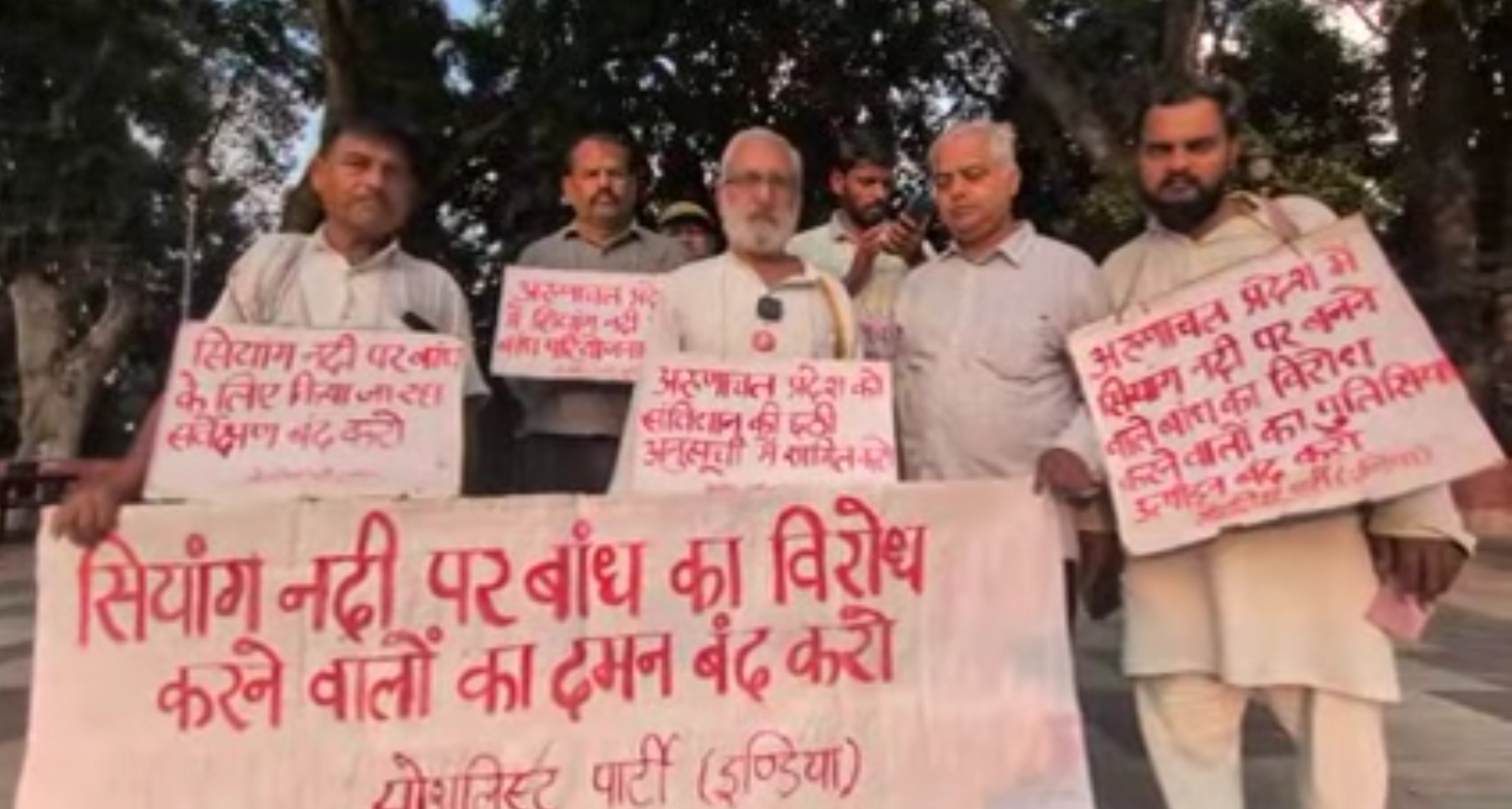
SP(I) Demands the Immediate Release Of All Arrested Activists
The Environmentally-Destructive Project Must Be Withdrawn, and Arunachal Pradesh Included In the Sixth Schedule.
Recent weeks have seen extensive protests by the people of Arunachal Pradesh against the proposed construction of a 11,200 MW hydroelectric dam on the Siang river. The dam is to be built by the public sector hydroelectric company National Hydroelectric Power Corporation (NHPC) as part of the Siang Upper Multipurpose Project (SUMP). Large demonstrations have taken place in the city of Pasighat in East Siang district, in the state capital, Itanagar, and at the Arunachal Bhawan in Delhi. On October 23rd and 24th, protestors in Arunachal Pradesh reacted to government apathy and police repression by vandalising the homes of two MLAs and the BJP state president, and the office of the NHPC in Pasighat. They also set fire to many government and police vehicles.
The police resorted to brutal lathi charge in which 67 people were injured, including an old woman who sustained a broken rib. At least twenty six people have been arrested and many more detained. On October 31, the police also detained several people who were protesting in front of Arunachal Bhawan, Delhi. Those arrested in Arunachal Pradesh include the prominent human rights lawyer and environmental activist Ebo Mili, and the youth leaders and activists Adum Tayom, Okut Paloh, Oson Paron, Omak Paron, Tajong Talom and Otul Jerang. The eminent Arunachali journalist Tongam Rina has been subjected to harassment by the police due to her coverage of the protests. The freedom of movement of ordinary people in the Siang valley region has been severely restricted, and large contingents of military and paramilitary forces deployed.
In spite of the protests, the government is actively preparing the ground for the construction of the dam. A preliminary survey of the land is underway. In what appears to be an attempt to bribe the locals into consenting, the NHPC has proposed a 350 crore CSR ‘development package’ to boost local infrastructure and livelihood opportunities. Locals contend that such development is of no use if their lands will eventually be submerged. Reportedly, the District Magistrate, Siang has used these CSR funds to buy two Mahindra Bolero vehicles and taken Rs. 20 lakhs for a ‘secret fund.’
It has also been claimed that the consent forms produced by the NHPC are misleading as they have been signed by people who will not be directly affected by the project. Also, consent given by one family member has been taken as consent of the whole family, even though in many instances this is far from the case. Activists and community leaders on the ground claim that about 80% of the people affected are against the dam. A Mumbai-based private PR agency has been paid over Rs. 10 crore by the corporation for launching an online PR campaign glorifying the project and vilifying the protestors, so as to manufacture support among the wider population
According to multiple independent fact-finding reports, the dam poses a grave threat to the land, livelihood, culture, and way of life of the people of the Siang valley region. If its construction goes through, it will result in the complete submergence of 27 villages in the Siang and Upper Siang districts, and will indirectly affect dozens more. A total of 1.5 lakh people are expected to be displaced by SUMP, which amounts to almost 11% of the population of Arunachal Pradesh.
The vast majority of those who will be affected belong to the indigenous Adi tribe. For the Adis, the Siang valley is not only their homeland and source of livelihood, but also holds tremendous historical, religious and cultural significance. The community has inhabited the land and been sustained by the Siang river for thousands of years. They worship the river as their ‘Ane’ or Mother.
The environmental costs of the project are expected to be immense. The Himalayan region is ecologically fragile as it is, and, as the recent devastating flood in Nepal attests, disproportionately affected by climate change. In recent decades, experts around the world have criticised big dams for their adverse environmental effects, and proposed many viable small-scale alternatives.
In the last few months, the government has been portraying SUMP as necessary to counter the 60,000 MW dam being built upstream by China. It has claimed that without control over the flow of the river downstream, India will be vulnerable to flooding and drought based on how the Chinese government chooses to channel the water upstream. Since the reservoir of China’s dam will have a capacity of 5.5 billion cubic metres, while the Indian reservoir will be able to hold 9.2 cubic metres, the dam will allow India to safely contain any excess water China might release. However, this narrative appears to be dubious for at least two reasons.
Firstly, SUMP is not a recently conceptualised project but was first proposed in 2008-09, when there was no Chinese dam in the picture. The NHPC started conducting preliminary surveys in 2017, during which the details of the project reached the common people of the region. This led to protests which disrupted the preliminary process and eventually stalled the project. Recent news of China’s under-construction dam and its purported national security risks appear to have given the authorities a new excuse to push the project through.
Secondly, if China were to decide to use its dam as an instrument of warfare, it is unlikely that the Indian dam will be able to prevent this. Even though India’s reservoir is larger, it seems impossible to ensure that it will have enough available capacity at the exact moment China decides to launch a hydraulic attack. What if the Indian reservoir is already full (say due to heavy rains in the monsoon season) when China’s 5.5 billion cubic meters of water is released? A much wiser approach would be to cultivate positive diplomatic relations with China, and to seek transparency and cooperation in the building of their dam. Since the downstream territory belongs to India, it is entitled by international law to seek comprehensive information on China’s dam. Experts have proposed that the countries carry out a joint impact assessment, so that both sides can fully comprehend the repercussions and move forward with adequate caution and mutual understanding.
Given the above facts, going ahead with the construction of the Siang dam is wholly unjustified. The government’s insistence on doing so exposes their ulterior motives – which are ultimately about state and corporate control over land, and the consolidation of power and wealth in the hands of a few. This is yet another manifestation of the present government’s policy of further marginalising the marginalised people of this country.
The SP(I) demands that all arrested and detained protestors be released immediately, and all FIRs filed against them be withdrawn. We demand that all restrictions imposed on the movement of ordinary people within the state, and on the functioning of the media be removed. All military forces deployed to suppress the voices of ordinary people should be withdrawn.
SP(I) expresses its solidarity with the people of the Adi community, and strongly condemns the violent repressive measures being carried out against them. The government cannot impose a development project of this scale on an unconsenting local population. We are a democratic nation in which everyone, particularly our indigenous people, have the right to participate in decision-making regarding development projects in their own region. Considering the grave threat this government presents to the environment and natural resources of Arunachal Pradesh, the long-standing demand to include the state in the Sixth Schedule of the Constitution should be implemented.
Mir Shahid Saleem (Ph: 9622002001)
Vice-President and Spokesperson
Socialist Party (India)
Leave a Reply